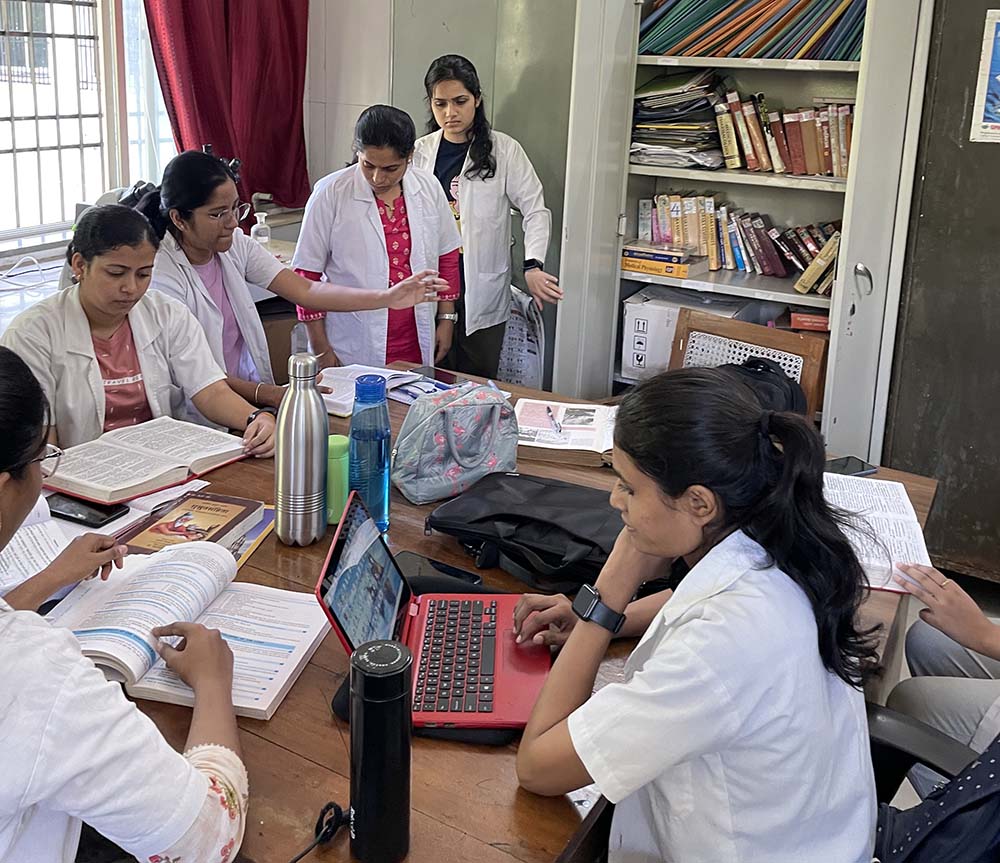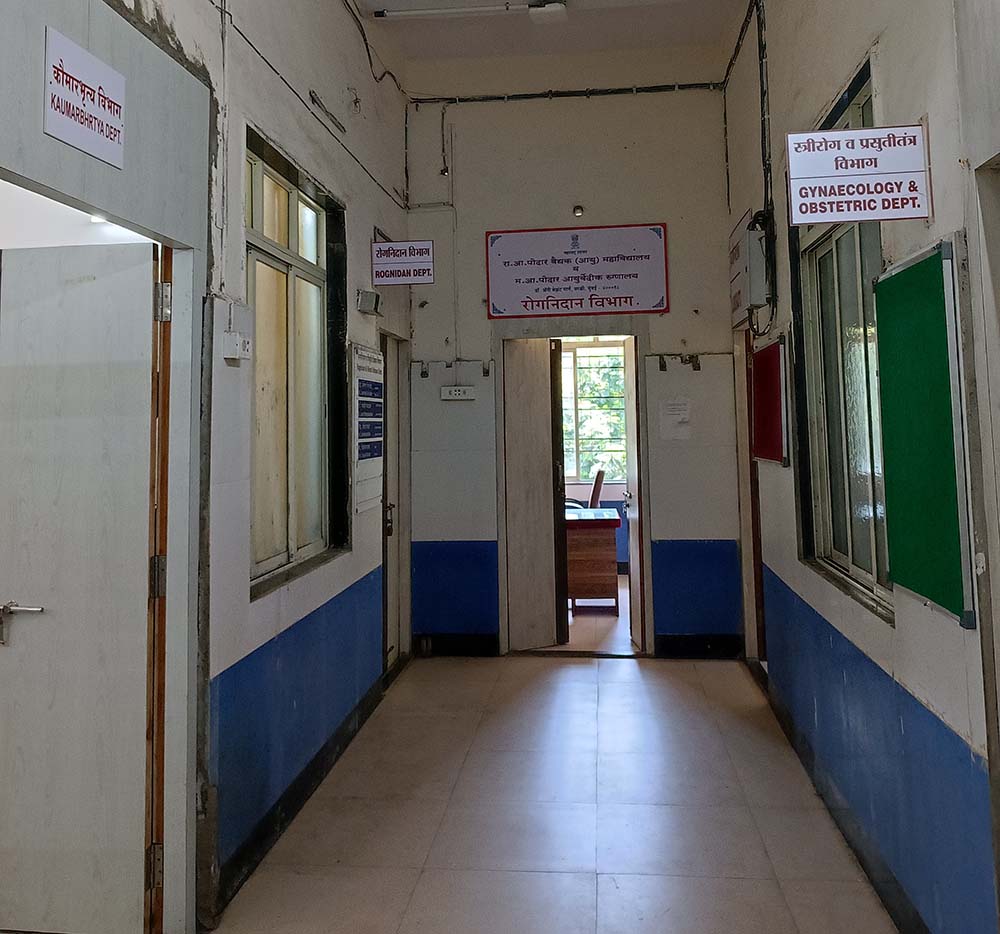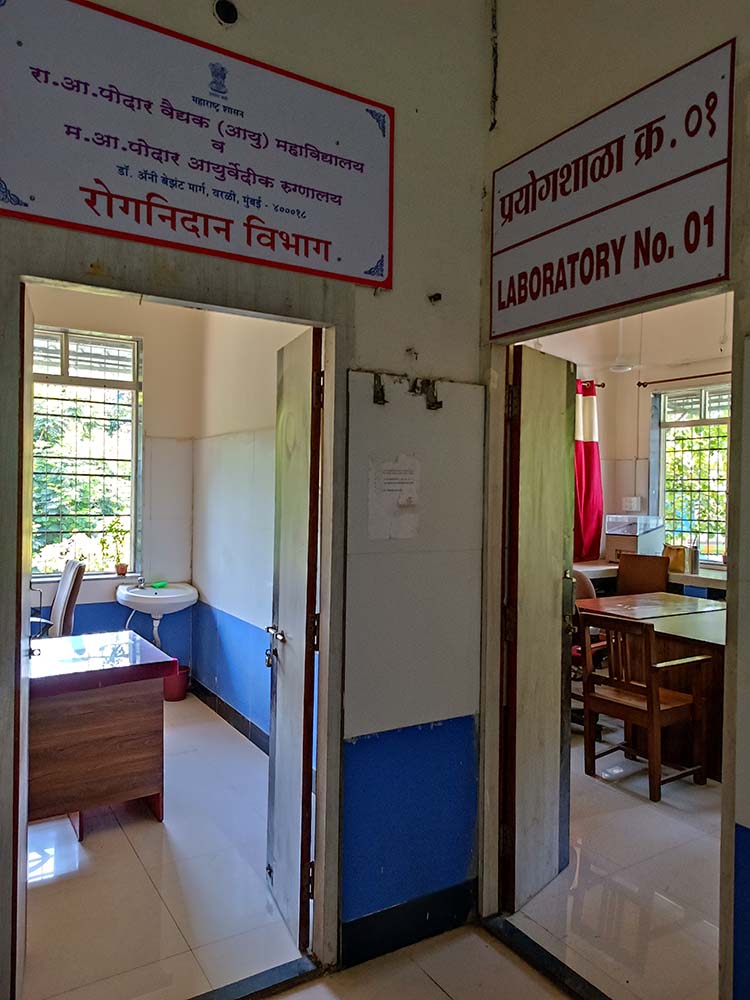


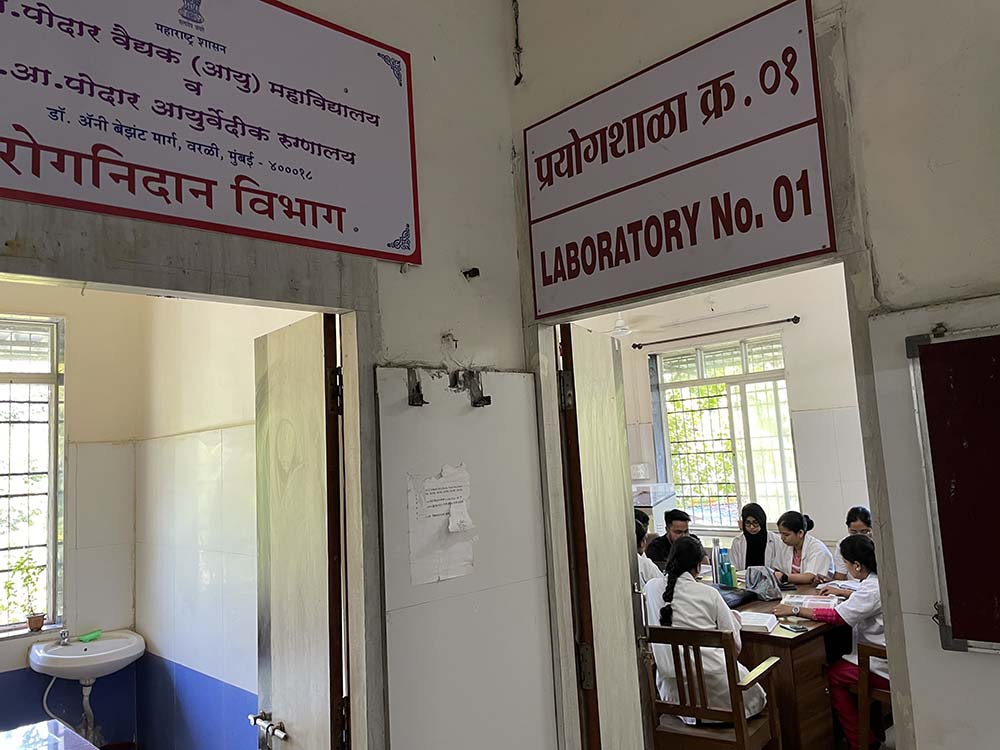
The Department of Rognidan Evam Vikriti Vigyan at RAPMC is a well-established unit offering both Undergraduate and Postgraduate education in Ayurvedic diagnostics. The undergraduate section is equipped with a spacious student laboratory, a departmental museum, and dedicated full-time faculty members to facilitate effective teaching and practical training.
The department also operates a fully functional Central Pathology Laboratory, which works continuously and serves as a major diagnostic support system for the R. A. Podar Medical College (Ayu.) and M. A. Podar Hospital, Worli, Mumbai. This laboratory plays a crucial role in providing essential pathological investigations required for clinical diagnosis and patient management.
Rognidan–Vikriti Vigyan forms the fundamental basis for all clinical branches of Ayurveda. The subject focuses on understanding diseases in detail (Vyadhi Vidnyana), their pathogenesis (Samprapti Vidnyana), and various methods of clinical examination (Aatur Pariksha or Rogi Pariksha). It also emphasizes recognition of clinical manifestations, selection of appropriate investigations (Vyadhi Pariksha) and interpretation of diagnostic findings. In addition, the subject deals with assessing the prognosis of diseases (Sadhya–Asadhyata), thereby enabling students to develop both theoretical understanding and practical competence in disease diagnosis.
The department also conducts the Postgraduate Degree Program – M.D. (Rognidan Evam Vikriti Vigyan), which focuses on developing expertise in Ayurvedic diagnostic science along with modern investigative methods.
Vision
To emerge as a center of excellence in Rognidan Evam Vikriti Vigyan, promoting accurate disease diagnosis through integration of classical Ayurvedic diagnostic principles with modern investigative techniques, while fostering quality education, research, and patient care.
Mission
- To provide quality education and training in Ayurvedic diagnostic science to undergraduate and postgraduate students.
- To promote accurate disease diagnosis through integration of classical Ayurvedic principles and modern diagnostic techniques.
- To support clinical services and research activities through reliable laboratory investigations and academic excellence.
Objectives
- To impart high-quality undergraduate and postgraduate education in Ayurvedic diagnostics with emphasis on clinical and laboratory training.
- To develop proficiency in Ayurvedic diagnostic methods including Rogi Pariksha, Vyadhi Pariksha and Samprapti analysis for comprehensive understanding of disease processes.
- To strengthen diagnostic services and promote research by integrating Ayurvedic concepts with modern laboratory investigations.
Undergraduate Teaching Laboratory
- The department has a spacious and well-equipped laboratory for undergraduate students, providing facilities for practical training in hematology, clinical pathology, and basic diagnostic investigations as per the academic curriculum.
Diagnostic Zone - Central Diagnostic Laboratory
- The department operates a fully functional Central Diagnostic Laboratory which provides essential pathological investigations. It acts as a major diagnostic support system for the R. A. Podar Medical College (Ayu.) and M. A. Podar Hospital by assisting in clinical diagnosis and patient management.
Skin Specialty OPD
- The department runs a Skin Specialty OPD dedicated to the diagnosis and management of various dermatological disorders using Ayurvedic principles. Patients presenting with conditions such as eczema, psoriasis, fungal infections, acne, pigmentation disorders, allergic skin conditions, and chronic non-healing skin lesions are evaluated in detail.
Departmental Museum
- The department maintains a museum containing charts, and teaching models that help students understand disease processes, pathology and diagnostic concepts in a systematic manner.
Postgraduate Teaching and Research Facilities
- The department offers facilities for postgraduate education in M.D. (Rognidan Evam Vikriti Vigyan), including seminar presentations, case discussions, research activities and dissertation work.
Experienced Faculty and Academic Support
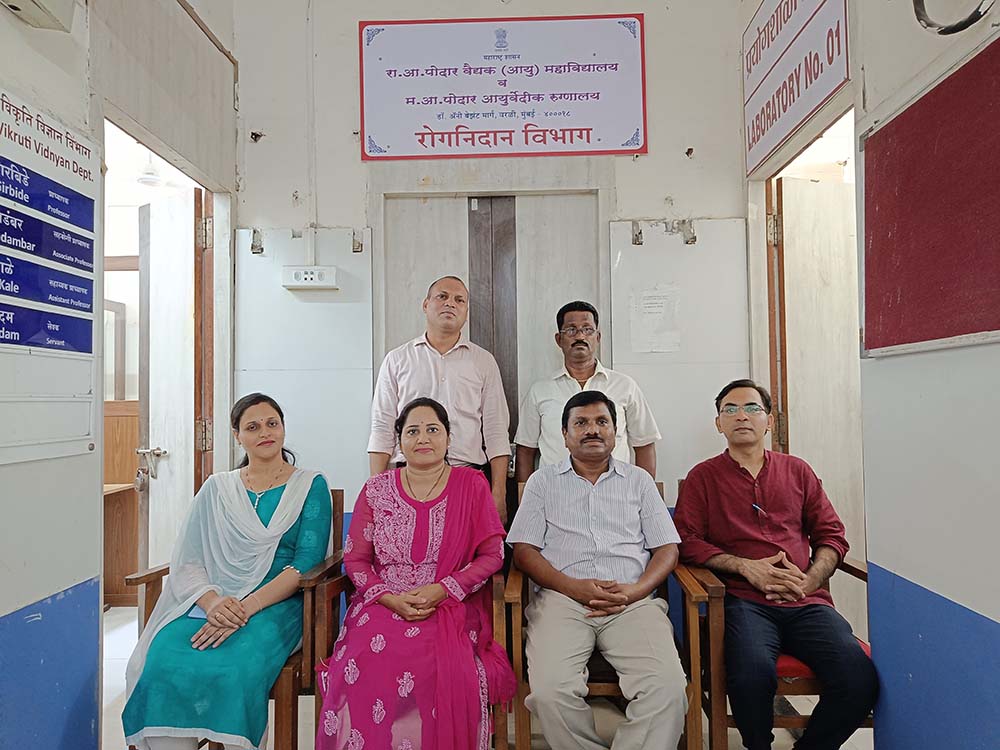
- The department is supported by qualified and dedicated faculty members who guide students in academic learning, practical training, and research activities.
| Name | Designation | Qualification |
|---|---|---|
| Dr. Santosh Govindrao Girbide | HOD & Professor | BAMS, MD (Rognidan evam Vikruti Vigyana) |
| Dr. Jyoti Vishnu Meghdambar | Associate Professor | BAMS, MD, PhD (Rognidan evam Vikruti Vigyana) |
| Dr. Sandeep Dhanaji Kale | Assistant Professor | BAMS, MD, PhD (Rognidan evam Vikruti Vigyana), MA Yogashastra |
| Dr. Renuka Bhushan Sawant | Assistant Professor | BAMS, MD (Rognidan evam Vikruti Vigyana) |
P.G. Scholars Details
| Sr. No | Name of P.G Scholar | Year | Name of P.G Guide | Title |
|---|---|---|---|---|
| 1 | Dr. Kuldeep Verma | 2007 - 2010 | Dr. Anuradha Reddy | "Dhatri Choorna Ka Amlapitta Mein Upashayatmaka Adhyayana". |
| 2 | Dr. Madhavi Gaikwad | 2008 - 2011 | Dr. Anuradha Reddy | "The Study Of Upashaya-Anupshayatmak Effect Of Dashamuladi Kwath In Gridhrasi With Special Reference To Sciatica" |
| 3 | Dr. Dinesh Brahmankar | 2008 - 2011 | Dr. Vijay R. Potdar | "Etiopathological Study Of Hypertension In Ayurvedic View". |
| 4 | Dr. Mithun Pawar | 2010 - 2013 | Dr. Anuradha Reddy | "The Etiopathological Study Of Vicharchika With Special Reference To Eczema." |
| 5 | Dr.Sachin Rohani | 2010 - 2013 | Dr. Vijay R. Potdar | "The Etiopathological Study Of Tamak Swasa With Comparative Study Of Bronchial Asthma". |
| 6 | Dr.Sandhya Pathak | 2013 - 2016 | Dr. Santosh Girbide | "A Comparative Clinical Study Of Nidan Parivarjan In Urdhvag Amalpitta With Pippli Ghrita". |
| 7 | Dr.Ashwini Patil | 2013 - 2016 | Dr. Anuradha Reddy | "A Comparative Study To Evaluate The Effect Of Nidan Parivarjan In Vicharchika With Yashadamrit Malhara" |
| 8 | Dr.Ashwini Parade | 2014 - 2017 | Dr. Santosh Girbide | "A Comparative Clinical Study Of Navaka Guggulu With Nidanparivarjan In Atisthoulya (Obesity)". |
| 9 | Dr.Snehal Bankar | 2014 - 2017 | Dr. Anuradha Reddy | "A Comparative Clinical Study To Evaluate The Effect Of Nidanparivar Jana In Sthoola Pramehi With Dvinishatriphala Sheetkashaya". |
| 10 | Dr.Mangesh Kathe | 2015 - 2018 | Dr.Deelip Puri | "An Etiopathological Study Of Madhumeha And Its Association With Oja Vikruti". |
| 11 | Dr. Pooja Chandane | 2015 - 2018 | Dr. Anuradha Reddy | "Study Of Asthivaha Srotas Dushti In Khalitya". |
| 12 | Dr.Prerna Raut | 2016 - 2019 | Dr. Santosh Girbide | "The Observational Study Of Urdhwaga Amlapitta To Determine Its Association With Bhuktwa Diwaswapna As A Hetu." |
| 13 | Dr.Sunita Malewade | 2016 - 2019 | Dr. Santosh Girbide | "An Observational Study Of Sandhigata Vata To Determine Its Association With Prajagarana As A Hetu." |
| 14 | Dr.Priti Sutar | 2017 - 2020 | Dr. Santosh Girbide | "A Case Control Study Of Amavata With Special Reference To Snigdhha Bhojanottar Vyayama As A Hetu." |
| 15 | Dr.Pooja Singh | 2017 - 2020 | Dr. Santosh Girbide | "Cross Sectional Study Of Assessment Of Ashtadosha In Atisthula With Reference To Lipid Profile." |
| 16 | Dr.Namrata Kulkarni | 2018 - 2021 | Dr. Santosh Girbide | "A Cross Sectional Study Of An Association Of Doshanubandhi Amavata With C-Reactive Protein Test And Erythrocyte Sedimentation Rate." |
| 17 | Dr. Namrata Dhake | 2019 - 2022 | Dr. Santosh Girbide | "A Cross Sectional Study To Assess The Status Of LFT In Raktapradoshaja Vyadhi With Special Reference To Asrugdara" |
| 18 | Dr.Gitanjali Wankhade | 2019 - 2022 | Dr. Milind Kamble | "A Cross Sectional Study To Assess The Status Of Liver Function Test In Raktapradoshaj Vyadhi With Special Reference To Kshudra Kushtha" |
| 19 | Dr.Sanjukta Deshmukh | 2020 - 2023 | Dr. Santosh Girbide | "An Observational Cross Sectional Study To Determine Occurrence Of Vatarakta In Bike Riders." |
| 20 | Dr.Geeta Mulk | 2020 - 2023 | Dr. Sandeep Kale | "An Observational And Analytical Study Of Urine Routine Analysis In The Patients Consuming Santarpanjanya Hetu With Special Reference To Mutrakruchha". |
| 21 | Dr. Swati Wasnik | 2020 - 2023 | Dr. Santosh Girbide | "An Observational And Analytical Study Of Urine Physiochemical Examination In The Sthool And Krush Madhumeha." |
| 22 | Dr.Maithili Dhulap | 2021 - 2024 | Dr. Santosh Girbide | "An Observational Cross Sectional Study Of Shadrupa Rajayakshma In Acid Fast Bacilli Sputum Positive Patients." |
| 23 | Dr. Deepamala Tripathi | 2021 - 2024 | Dr. Santosh Girbide | "An Observational Cross Sectional Study To Determine Occurrence Of Mutrakruchha In Bus Drivers." |
| 24 | Dr. Himani Giri | 2021 - 2024 | Dr. Jyoti Meghdambar | "An Observational Study Of Pattern Of ECG Findings In Patients Of Pandu Roga With Special Reference To Anaemia." |
| 25 | Dr.Fareeda Khan | 2022 - 2025 | Dr. Sandeep Kale | "An Observational Study Of Tridosha In Human Breast Milk By Jala Pariksha And Colour Analysis." |
| 26 | Dr. Amol Kakad | 2022 - 2025 | Dr. Santosh Girbide | "Cross Sectional Study To Determine The Prevalence Of Madhumeha In Office Desk Workers With Special Reference To Eksthanasan" |
| 27 | Dr. Dhanashree Paikrao | 2022 - 2025 | Dr. Jyoti Meghdambar | "A Cross Sectional Study Of Prameha Purvarupa In Medoroga With Reference To HbA1c Levels" |
| 28 | Dr. Supriya Kharat | 2023 - 2026 | Dr. Jyoti Meghdambar | "A Cross Sectional Study To Determine Association Between Viruddha Ahar And Vatarakta With Special Reference To Sanyoga Viruddha" |
| 29 | Dr. Darshan Akhade | 2023 - 2026 | Dr. Santosh Girbide | "A Cross Sectional Study Of Anna-Vaha Strotodushti Lakshana In Tamak Shwas With Reference To DLC" |
| 30 | Dr.Abhinav Kedari | 2023 - 2026 | Dr. Sandeep Kale | "An Observational Study Of Interpretation Of Tail Bindu Mutra Pariksha In Patients Of Diabetes Mellitus With Higher Glycosylated Hemoglobin" |
| 31 | Dr. Ruhatbi Mirkar | 2024 - 2027 | Dr. Santosh Girbide | "A Cross Sectional Study To Understand The Prevalence Of Udakavaha Strotodushti Lakshana In Tamak Shwas With Reference To Bronchial Asthma" |
| 32 | Dr. Shubham Mirashe | 2024 - 2027 | Dr. Jyoti Meghdambar | "An Observational Study To Validate The Results Of Tail Bindu Mutra Pariksha In Patients Of Amavata With Reference To Rheumatoid Arthritis" |
| 33 | Dr. Rutuja Chavan | 2024 - 2027 | Dr. Sandeep Kale | "A Case Control Study For Assessment Of Association Between Krodh And Grahani." |
| 34 | Dr. Krushna Jadhav | 2025 - 2028 | Dr. Santosh Girbide | - |
| 35 | Dr. Karishma Bansode | 2025 - 2028 | Dr. Jyoti Meghdambar | - |
| 36 | Dr. Umesh Patil | 2025 - 2028 | Dr. Sandeep Kale | - |
The Central Diagnostic Laboratory of the Department of Rognidan Evam Vikriti Vigyan provides essential diagnostic services to support clinical diagnosis and patient management in the M. A. Podar Hospital, Worli, Mumbai. The laboratory is well-equipped with fully automated analyzers and modern diagnostic instruments to ensure accurate and reliable investigations.
Hematology Investigations
- Hemoglobin estimation, Total and Differential Leukocyte Count (TLC/DLC), platelet count, Peripheral Blood Smear examination, ESR and other routine hematological tests.
Clinical Pathology
- Routine urine examination, stool examination and other microscopic investigations.
Biochemical Investigations
- Blood sugar and other routine biochemical tests for clinical evaluation.
HIV Screening Services
- The laboratory provides HIV screening tests as per standard diagnostic protocols.
Automated Laboratory Facilities
- The laboratory is equipped with fully automated machines and analyzers, ensuring precision, efficiency and timely reporting of investigations.
Diagnostic Support for Clinical Departments
- Laboratory findings assist clinicians in accurate diagnosis, monitoring of disease progression and effective patient management.
Nadi Tarangini (Pulse Analysis System)
The department utilizes Nadi Tarangini, an advanced pulse analysis device developed for objective assessment of Nadi Pariksha. This system records pulse waveforms digitally and helps in analyzing Vata, Pitta, and Kapha dominance, thereby supporting traditional Ayurvedic diagnostic interpretation with scientific data.
Rakta Varna Examination Model (AI-Based Blood Color Analysis)
A novel diagnostic model for Rakta Varna Pariksha has been developed by Dr. Sandip Kale, which utilizes Artificial Intelligence for blood color analysis. This model aims to standardize the traditional Ayurvedic assessment of blood characteristics and assists in correlating classical descriptions with objective digital evaluation.
Stanya Parikshan Model
The department has also developed a Stanya Parikshan Model by our Postgraduate Scholars, designed for systematic evaluation of breast milk based on classical Ayurvedic parameters. This model supports teaching, clinical assessment, and research in Stanya Dushti and neonatal health.
Tail Bindu Mitra Pariksha Model
Our PG scholars have developed an educational and diagnostic Tail Bindu Mitra Pariksha Model to demonstrate and analyze urine-based diagnostic principles described in Ayurveda. This model helps students and researchers understand the classical methodology and its clinical implications.
These innovative initiatives reflect the department’s commitment to bridging classical Ayurvedic diagnostic wisdom with modern research methodologies and technological advancements.
The laboratory also serves as an important training facility for undergraduate and postgraduate students, where they gain practical experience in performing laboratory investigations and interpreting diagnostic findings.
The Department of Rognidan Evam Vikriti Vigyan is well-developed and fully equipped in accordance with the norms and standards prescribed by NCISM. All the infrastructural requirements as per the Minimum Standard Requirements (MSR) for the Rognidan department and its associated laboratory are completely fulfilled. The department ensures availability of adequate space, essential equipment, instruments, teaching aids, and laboratory facilities required for both undergraduate and postgraduate education, as well as for providing efficient diagnostic services.
The department strives to uphold excellence in Ayurvedic diagnostic science through quality education, reliable laboratory services, and continuous academic development. It remains committed to nurturing competent physicians with strong diagnostic skills and scientific outlook.